This website uses cookies
In order to optimize our website and improve it continuously, we use cookies. Further information on cookies can be found under the link "Show cookie details" and in our privacy policy. You give your consent to our cookies if you hide this notice by clicking on an accept button. Here you can find our Privacy Policy.
Only accept selected
Reject
Accept all

Show cookie detailsHide cookie details
Necessary cookies enable basic functions of the website.

Name cookieconsent-media
Provider Eigentümer dieser Website
Purpose
Saves the approval status of the user for external media cookies on the current website.
Period of validity 1 year
Type HTTP Cookie

Name cookieconsent-necessary
Provider Eigentümer dieser Website
Purpose
Saves the consent status of the user for cookies on the current website.
Period of validity 1 year
Type HTTP Cookie

Name cookieconsent-statistics
Provider Eigentümer dieser Website
Purpose
Stores the user consent status for statistics cookies on the current website.
Period of validity 1 year
Type HTTP Cookie

Name fontSize
Provider Owner of this website
Purpose
Saves the font size setting that is set by the accessibility tool.
Period of validity 1 year
Type HTTP Cookie

Name isGrayScale
Provider Owner of this website
Purpose
Saves the grayscale setting that is set by the accessibility tool.
Period of validity 1 year
Type HTTP-Cookie

Name isHighContrast
Provider Owner of the website
Purpose
Saves the contrast setting that is set by the accessibility tool.
Period of validity 1 year
Type HTTP-Cookie

Name PHPSESSID
Provider Eigentümer dieser Website
Purpose
Cookie of PHP (programming language), PHP data identifier. Contains only a reference to the current session. No information is stored in the user's browser and this cookie can only be used by the current website.
Period of validity End of session (close the browser)
Type HTTP Cookie
Content from external providers such as Vimeo or GoogleMaps is blocked by default. If cookies are accepted by external media, access to these contents no longer requires manual consent.

Name muxData
Provider vimeo.com
Purpose
This cookie is used in combination with a video player. If the visitor is interrupted while viewing video content, the cookie remembers where to start the video when the visitor reloads the video.
Period of validity End of session (close the browser)
Type HTTP Cookie
These cookies collect anonymous statistics. This information helps us to understand how we can further optimize our website.

Name _ga
Provider google.com
Purpose
Registers a unique ID used by Google Analytics to generate statistical information about how the visitor uses the site.
Period of validity 2 years
Type HTTP Cookie

Name _gat
Provider google.com
Purpose
Used by Google Analytics to limit the request rate.
Period of validity 1 day
Type HTTP Cookie

Name _gid
Provider google.com
Purpose
Registers a unique ID used by Google Analytics to generate statistical information about how the visitor uses the site.
Period of validity 1 day
Type HTTP Cookie
GSG Tummescheit Logo - Link zur Startseite

Historical Box locks - Information

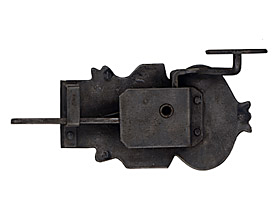
Surface-mounted locks are fitted onto a door and their mechanism is visible on the outside. Surface-mounted locks almost exclusively have toggle handles and a lifting latch. They are manufactured as replicas and are usually only required when historic buildings are being converted into museums.

Mortise locks conceal their mechanism with an angled cover plate and are inserted into the side of the door. The short side of the plate forms the lock faceplate.

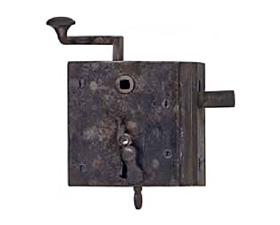
Box locks are nothing more than surface-mounted locks whose mechanism is protected by a box. They are the locks commonly used in the 18th and 19th centuries.

Examples of Historical Box locks


Box locks are divided into three types:

Toggle latch locks:
In these locks, a latch protrudes from the upper edge of the box. The handle is used to lift the latch out of the strike plate. The other side has a handle with a pin that is inserted through the lock nut.

Mortise locks:
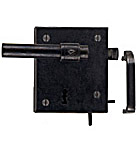
Like lever locks, they have a lifting latch. The handles lie flush against the nut on the lock side.

Locks with a shooting latch:
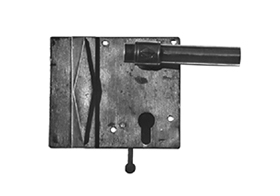
They differ from the previous type only in that the latch protrudes into the strike plate. The locks described above are used because doors used to be 20-32 cm thick and the mortice locks commonly used today cannot be fitted into such doors.

We also refurbish old box locks and adapt them for use on doors such as church entrances, allowing profile cylinders to be installed. Decorative strips can be added as requested or according to a drawing. However, lock cases can only be enlarged in iron if the backset is retained. The backset refers to the distance between the faceplate and the centre of the handle spindle.

Surfaces and materials

An overview of the abbreviations used and the available materials and surface treatments for the fittings can be found on the corresponding subpage:

Table: Surfaces | Abbreviations used

Fe: Eisen's raw
Fea: Old iron seasoned with oil
FeZis: Black galvanised iron
FeBl: covered with sheet iron, raw
FeBla: covered with sheet iron, oil-fired
FeBlZis: covered with sheet iron, black galvanised
MspBl: covered with brass sheet, polished
MsaBl: covered with brass sheet, old
The available materials and surface treatments for the fittings can be seen from the abbreviations in the table above (drop-down button).